

The Technology Shift Changing Global Health Care


New investments show why hardware alone cannot fix our global medical shortages.

We often think of medical breakthroughs as new pills or complex machines, but the next big shift might just be an algorithm that schedules appointments and files paperwork.
Takeaways
Gates isn't backing just one medical gadget.
The Horizon1000 project relies on OpenAI tools.
AI reduces paperwork to free up doctors.
Tech requires reliable electricity and internet access.
Handheld AI ultrasounds improve maternal health checks.
Have you ever sat in a waiting room for three hours just to see a doctor for five minutes? It's a frustrating reality. But in many parts of the world, that wait isn't just annoying. It's a matter of life and death. I've noticed that when we talk about fixing health systems, we usually picture a brilliant new drug or a massive MRI machine.
Bill Gates is taking a different approach right now. He isn't backing one single invention. The Gates Foundation is funding a broad set of software programs, data maps, and delivery logistics. The most talked-about piece is a $50 million initiative called Horizon1000. They teamed up with OpenAI to bring artificial intelligence to 1,000 primary care clinics in Africa by 2028. The pilot starts in Rwanda.
So how exactly does a chatbot help a crowded clinic?
The Promise of Clinic Workflows

Think about what a nurse actually does all day. A huge chunk of their shift involves filling out forms, writing clinical notes, and figuring out supply logistics. AI is incredibly good at those specific chores.
The goal of Horizon1000 is to handle patient triage and intake. A patient arrives and describes their symptoms. An AI tool logs the details and pulls up relevant clinical guidelines for the nurse to review. This cuts down the paperwork. It lets doctors and nurses spend their limited time actually looking at the patient and treating them.
This approach makes a lot of sense when you look at the numbers. Rwanda has about one healthcare worker for every 1,000 people. We can't just snap our fingers and train five million new doctors overnight. But we can use software to make the existing doctors more efficient.
And the effort goes beyond text generation. The Gates Foundation has also invested heavily in AI-enabled handheld ultrasounds. These plug right into a mobile phone or a basic tablet. An algorithm helps a nurse sweep the probe across a pregnant belly to identify high-risk conditions. That nurse doesn't need to be a highly trained sonographer to get an accurate reading. The software automatically highlights the issues on the screen.
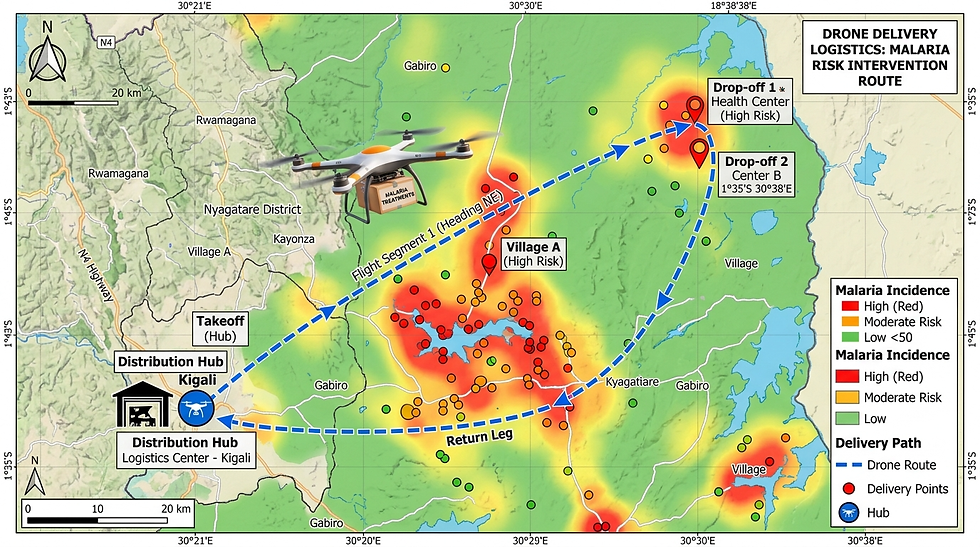
They are also funding disease surveillance systems. Things like geographic mapping can predict where a malaria outbreak might happen next. A health official can look at a digital map that updates in real time to show where mosquito breeding grounds are forming. This means they know exactly where to send preventative medicine before the outbreak hits a village. The foundation also points to innovations like maternal vaccines for respiratory syncytial virus (RSV).
When you combine a targeted vaccine with improved geospatial disease mapping, you aren't just reacting to sick patients. You are stopping the disease from reaching the clinic in the first place.

Then you have drones. Small autonomous planes can fly over washed-out dirt roads to drop off vaccines and blood plasma directly into the courtyard of a rural hospital. The focus is simply getting the right supplies and information to the right place at the exact right time.
The Risks of Digital Overreach
All of this sounds incredibly promising. I think we have to ask some tough questions about the reality on the ground though. You can't run an AI program on hope alone.

First, there's the infrastructure problem. About a billion people globally rely on clinics that don't have reliable electricity. You need power, and you need a solid internet connection to make cloud-based software work. If a clinic loses power, does the entire intake system crash? A flashy algorithm does no good if the tablet battery is dead.
We also have to think about the human element. Technology is meant to support clinical judgment. It shouldn't replace it. The people building these systems say humans will always stay in charge. But a busy, exhausted nurse might just click "agree" on whatever the AI suggests. That's a real risk.
We also face serious language barriers. Many AI tools are trained mostly on English data. If a tool can't process local languages like Kinyarwanda accurately, it could completely misinterpret a patient's symptoms. A bad translation in a medical setting is dangerous.
Finally, there's the issue of funding and data ownership. Throwing $50 million at a pilot program is a great start. But maintaining servers, updating software, and training staff costs money year after year. We have to wonder what happens when the initial grant money runs out. Plus, when a technology company processes the medical data of thousands of patients, who actually owns that data? We don't want a situation where patient privacy is an afterthought.
Looking to the Future
We're watching a massive experiment unfold right now. If Horizon1000 works in Rwanda, we will likely see it expand to Kenya, South Africa, and Nigeria.
The real test will be whether this software fades into the background. Good technology should feel invisible. A nurse shouldn't feel like they are fighting with a computer. They should just feel like their job got a little bit easier.
The focus must remain entirely on the patient experience. If a mother in a rural village can get a faster diagnosis because an AI tool sorted her paperwork and read her ultrasound, that is a massive win.
We just have to make sure we build the electrical grids and the basic clinic walls alongside the software. That's the only way these programs will actually last. I'll be watching closely to see how the first 50 clinics perform this year.
FAQs
What is Horizon1000?
A $50 million AI healthcare initiative in Africa.
Who is funding the project?
The Gates Foundation and OpenAI provide the funding.
Will AI replace human doctors?
No. The tools handle paperwork and triage.
Where is the pilot starting?
The first clinics are located in Rwanda.
How do AI ultrasounds work?
They use algorithms to guide nurses through scans.
Citations
Cullinan, K. (2026, January 21). Gates and OpenAI Team Up to Pilot AI Solutions to African Healthcare Problems. Health Policy Watch. https://healthpolicy-watch.news/gates-and-openai-team-up-to-pilot-ai-solutions-to-african-healthcare-problems/
Forbes Africa. (2026, January 21). Billionaire-Backed Gates Foundation and OpenAI To Tackle Africa's Health Crisis Using AI. Forbes Africa. https://www.forbesafrica.com/technology/2026/01/21/billionaire-backed-gates-foundation-and-openai-to-tackle-africas-health-crisis-using-ai/
GeekWire. (2026, January 20). Gates Foundation, OpenAI launch $50M AI health initiative targeting 1000 clinics in Africa. GeekWire. https://www.geekwire.com/2026/gates-foundation-openai-launch-50m-ai-health-initiative-targeting-1000-clinics-in-africa/
Izadnegahdar, R. (2024, May 1). Ultrasounds in hand, midwives are transforming maternal health. Bill & Melinda Gates Foundation. https://www.gatesfoundation.org/ideas/articles/ai-ultrasound-maternal-health
Philips. (2024, May 8). How AI-enabled ultrasound helps increase access to maternal care. Philips. https://www.philips.com/a-w/about/news/archive/standard/news/articles/2024/20240508-how-ai-enabled-ultrasound-helps-increase-access-to-maternal-care.html


