

From Surviving to Thriving: Unlocking Vibrant Mental Health Through Counseling


How structured therapy and strong operational frameworks create lasting mental health outcomes.

This article highlights the chance to shift mental health care from crisis response to nurturing long-term growth and resilience. To thrive, we need skilled therapists, adequate infrastructure, financial resources, and evidence-based practices. As the demand for support increases, it’s essential for clinicians, administrators, and patients to understand the key elements that enable effective therapy. Together, we can create a healthier future.
Takeaways
Talking therapies work. Meta‑analytic data show psychotherapy is “remarkably effective, and its effects are robust and long‑lasting,”
Long‑term thriving requires structure. Sustained counseling, outcome tracking, and strong administrative systems prevent regression and support real psychological growth.
Billing determines care quality. Clinics cannot deliver high‑impact therapy if reimbursement systems fail — long‑term psychotherapy requires specialized billing expertise to stay financially viable.
Clinical infrastructure often treats mental health as a checklist of symptom reductions. After ten years of advising clinical practices and healthcare networks, I have seen how this narrow focus traps patients in basic survival mode. True clinical excellence aims higher. Moving patients from baseline survival to a state of vibrant mental health requires a shift toward structured, evidence-based counseling.
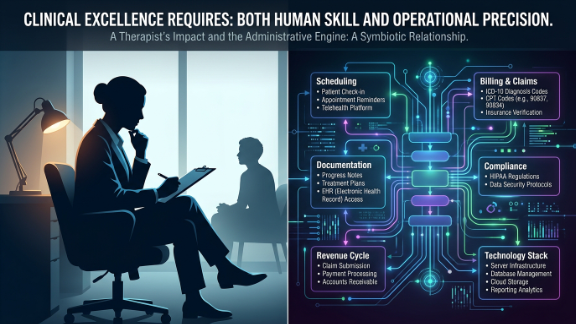
However, executing this strategy requires more than just skilled therapists. It demands robust administrative frameworks, optimized clinical workflows, and an elite mental health billing service to handle the complex financial mechanics of modern healthcare.
The Definitive Clinical Evidence for Talking Therapies
Clinical outcomes are the bedrock of any serious healthcare investment. For years, skeptics labeled counseling as a soft science with unpredictable results. Modern data completely refutes this outdated assumption. Extensive meta-analytic data show that legitimate psychotherapy achieves exceptional results in reducing human suffering across diverse psychiatric diagnoses [1]. The data demonstrates that structured counseling is a highly effective medical intervention.
Consider the baseline facts of clinical efficacy:
Counseling reduces clinical symptoms rapidly.
It builds long-term psychological resilience.
Patient satisfaction remains consistently high.
Relapse rates drop significantly over time.
Coping mechanisms improve across demographics.
As Dr. Bruce Wampold notes in his book The Great Psychotherapy Debate, "Psychotherapy is remarkably effective, and its effects are robust and long-lasting." This reality means that healthcare systems must prioritize counseling as a primary treatment route. However, a major bottleneck remains: administrative friction. A clinic cannot scale its counseling services if its revenue cycle is broken. Integrating an outsourced mental health billing service removes this operational friction, allowing therapists to focus entirely on patient care.
Comparing Global Functioning Outcomes
To understand how counseling helps a patient thrive rather than just survive, we must consider global functioning and overall quality of life. Many clinical frameworks rely solely on pharmaceutical options for speed. However, comparative clinical data reveal a much more nuanced reality regarding long-term patient health.
In a comprehensive meta-analysis evaluating depression treatments, researchers compared the long-term impacts of psychotherapy, pharmacotherapy, and combined treatments [2]. The findings were clear. While medications can quickly suppress acute symptoms, psychotherapy provides statistically superior long-term improvements in a patient’s actual daily functioning and global quality of life.
Patients don't just want fewer symptoms; they want a life they can succeed in.
Monotherapy with medication lacks skill-building.
Counseling teaches permanent cognitive strategies.
Patients strongly prefer talking therapies.
Side effects from pharmaceuticals damage compliance.
Long-term functioning requires behavioral changes.
Implementing these findings requires clinics to maintain strict financial viability, making a professional mental health billing service mandatory for modern practices. Managing insurance claims for long-term psychotherapy demands specialized knowledge that general billing services simply lack. Protecting your administrative framework is critical; if a billing service fails to secure proper reimbursement for extended therapy sessions, a clinic will naturally revert to shorter, less effective care models.

Operational Realities: Acute Care vs. Sustainable Progress
A common trap in behavioral health management is confusing short-term relief with permanent psychological growth. Industry consultants must look closely at the durability of clinical outcomes. Data from the Cochrane Database of Systematic Reviews indicate that primary care counseling yields substantial short-term improvements compared with standard general practitioner care [3]. However, these clear advantages can level off during long-term follow-ups if continuous support structures are omitted.
Brief counseling resolves immediate crises.
Long-term thriving requires sustained interventions.
Periodic check-ins prevent patient regression.
Structural support networks preserve clinical gains.
Care continuity prevents expensive hospital readmissions.
This reality requires a multi-layered approach to patient care. Short-term counseling serves as a vital catalyst for helping patients escape survival mode, but transitioning to a thriving life requires sustained, structured support.
Dr. Judith Beck, in her book Cognitive Behavior Therapy: Basics and Beyond, emphasizes this dynamic: "The goal of therapy is to make the patient their own therapist." Achieving this level of patient independence takes time and consistent clinical touchpoints. For a healthcare organization, maintaining long-term care pathways requires tight financial controls. If your internal team is overwhelmed by billing codes, patient care continuity will suffer. Partnering with an expert mental health billing service ensures your practice can financially sustain these extended, high-impact treatment paths without compromising revenue.
Modality Breakdown for Clinical Systems
Implementing clinical investments requires a clear understanding of how various treatment modalities impact symptom management, daily functioning, operational costs, and administrative billing complexity, as outlined in the table below.
Modality Type | Target Focus | Long-term Functioning | Patient Adherence | Billing Coding Complexity |
Pharmacotherapy | Symptom suppression | Moderate to low | Low due to side effects | Low (Standard E/M codes) |
Short-Term Counseling | Immediate crisis resolution | Moderate | High initial engagement | Moderate (Time-based codes) |
Long-Term Psychotherapy | Deep cognitive remodeling | High | High long-term retention | High (Requires specialized service) |
Combined Treatment | Dual systemic intervention | Highest overall | Variable | Very High (Complex coding) |
As the table shows, maximizing a patient's capacity to thrive requires higher-complexity operational and billing modalities. Managing long-term psychotherapy or combined care models demands an elite mental health billing service to accurately track session lengths, interactive complexity add-ons, and diagnostic codes. Without a specialized mental health billing service, clinics frequently underbill or face costly insurance audits, which ultimately harm access to patient care.

The True Mechanisms of Internal Psychological Change
Building a clinic that fosters true thriving requires a deep understanding of the precise psychological mechanisms that drive patient improvement. Change does not happen by accident; it occurs through structured cognitive processing and behavioral modifications. Modern research shows that effective psychological therapies work by directly altering a patient's underlying cognitive processing and phenomenological experience [4].
As Dr. David Burns states in his book Feeling Good: The New Mood Therapy, "Your emotions result entirely from the way you look at things." This core cognitive principle underpins successful therapeutic work.
Cognitive reframing alters neural pathways.
Behavioral activation breaks depressive cycles.
Emotional processing resolves historical trauma.
Skill acquisition improves stress tolerance.
Self-efficacy increases overall patient autonomy.
When therapists successfully activate these mechanisms, patients learn to navigate life's challenges independently. This is what separates surviving from thriving.
In The Gift of Therapy, Dr. Irvin Yalom writes, "It's the relationship that heals." This classic insight is backed up by modern data. Research indicates that specific psychotherapist skills, such as empathic reflection and Socratic questioning, are critical to a patient's improvement in self-concept [5]. The therapeutic alliance is a massive predictor of positive clinical outcomes.
Empathy fosters deep psychological safety.
Socratic questioning challenges maladaptive beliefs.
Clear goal alignment accelerates progress.
Mutual trust improves treatment adherence.
Skilled communication reduces drop-out rates.
Allowing this level of human connection to flourish requires clinical leaders to remove administrative distractions. A therapist cannot build a deep relationship with a patient if they are worried about credentialing errors or unpaid claims. Utilizing a professional mental health billing service removes this heavy administrative burden from your staff, freeing up the mental space therapists need to practice at the top of their licenses.
As Dr. Marsha Linehan writes in her book DBT Skills Training Manual, "The only way out is through." Therapists must guide patients through this intensive psychological work without being distracted by structural back-office delays.
Systemic Quality Control and Modern Access Barriers
As demand for mental health services continues to skyrocket, the behavioral health industry faces structural quality control issues. A policy white paper from the U.S. Department of Health and Human Services highlights that while evidence-based therapies have clear clinical benefits, the industry lacks unified performance metrics to ensure quality across diverse healthcare systems [6].
Standardized metrics improve clinical accountability.
Evidence-based practices ensure predictable outcomes.
Continuous monitoring tracks patient progress.
Quality data justifies insurance reimbursements.
Uniform training reduces provider performance variance.
Solving these systemic quality issues requires clinics to modernize their infrastructure. This includes adopting digital tools like telehealth and optimizing the revenue cycle. According to a policy report by the Alliance for Connected Care and the Ruderman Family Foundation, expanding digital access is vital for vulnerable populations, yet providers face severe regulatory and financial barriers [7].
Telehealth expands rural care access.
Cross-state licensing laws restrict care.
Insurance networks create artificial barriers.
Digital platforms require tight security.
Marginalized groups benefit from remote options.
Navigating these modern access barriers requires an agile business model. If your clinic uses telehealth to reach underserved communities, your billing system must adapt instantly to changing state codes and modifier requirements. An in-house billing team often struggles to keep up with these rapid regulatory changes.
By partnering with a dedicated mental health billing service, your practice can confidently expand its digital footprint. A specialized mental health billing service knows exactly how to handle out-of-state claims, telehealth modifiers, and complex insurance rules, ensuring your clinic remains profitable while expanding care access.

Strategic Takeaways for Behavioral Health Leaders
Transitioning your clinical practice from a model of basic survival to one that enables vibrant thriving requires a clear, deliberate strategy. Based on my ten years of experience consulting in this sector, here are the core operational steps you must take:
Prioritize evidence-based modalities like CBT.
Measure patient outcomes systematically every session.
Invest heavily in therapists' clinical skills.
Expand digital access via secure telehealth.
Outsource operations to a billing service.
Conclusion
True clinical excellence goes beyond symptom reduction. It requires evidence‑based counseling, long‑term care pathways, and operational systems that protect continuity. When clinics pair strong therapeutic frameworks with specialized mental health billing support, they create the conditions for patients not just to stabilize — but to thrive.
References
[1] Flückiger, C., Willutzki, U., Grosse Holtforth, M., & Wampold, B. E. (2024). Psychotherapy works – An inclusive and affirming view to a modern mental health treatment. Clinical Psychology in Europe, 6. https://pmc.ncbi.nlm.nih.gov/articles/PMC11303923/
[2] Kamenov, K., Twomey, C., Cabello, M., Prina, A. M., & Ayuso-Mateos, J. L. (2016). The efficacy of psychotherapy, pharmacotherapy and their combination on functioning and quality of life in depression: a meta-analysis. Psychological Medicine, 47(8), 1337-1337. https://pmc.ncbi.nlm.nih.gov/articles/PMC5244449/
[3] Bower, P., Knowles, S., Coventry, P. A., & Rowland, N. (2011). Counselling for mental health and psychosocial problems in primary care. Cochrane Database of Systematic Reviews, (11). https://pmc.ncbi.nlm.nih.gov/articles/PMC7050339/
[4] Salkovskis, P. M., Sighvatsson, M. B., & Sigurdsson, J. F. (2023). How effective psychological treatments work: mechanisms of change in cognitive behavioural therapy and beyond. Behavioural and Cognitive Psychotherapy, 51(6), 595-615. https://www.cambridge.org/core/journals/behavioural-and-cognitive-psychotherapy/article/how-effective-psychological-treatments-work-mechanisms-of-change-in-cognitive-behavioural-therapy-and-beyond/E204698C526F8F312606E7D4EEDB9BBB
[5] Hill, C. E., & Norcross, J. C. (2023). Research evidence on psychotherapist skills and methods: Foreword and afterword. Psychotherapy Research, 33(7), 821-840. https://www.tandfonline.com/doi/full/10.1080/10503307.2023.2186281
[7] Alliance for Connected Care & Ruderman Family Foundation. (2024). A Call for Change: Removing Barriers to Telehealth Mental Health Treatment for College Students. https://connectwithcare.org/wp-content/uploads/2024/06/White-Paper-Telehealth-for-College-Students.pdf
About the Author

Ricky Bell is a health writer and healthcare operations professional at Dastify Solutions. With over nine years of experience in revenue cycle management and medical billing workflows, he specializes in translating complex healthcare topics into clear, practical insights for providers and healthcare audiences. You can follow him on LinkedIn.


