

Is Your Most Private Data Safe With an AI Doctor?

Updated: Apr 15
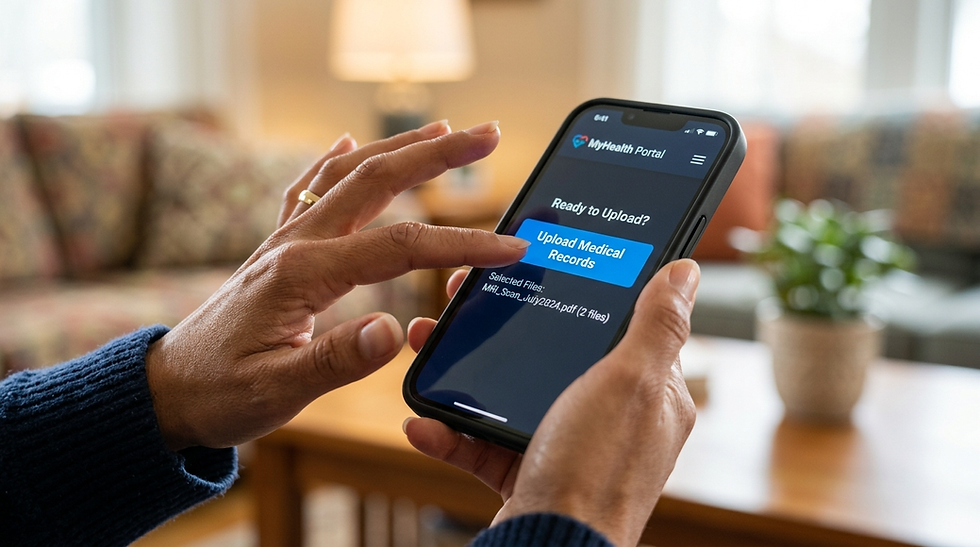
A guide to the new trend of uploading personal medical records for AI analysis, warning readers about the significant risks to their privacy and safety.

Addressing the intricate matters of data privacy, AI ethics, and medical accuracy alongside the familiar, daily worries of patients and their families. Rooting the conversation in real-world situations and a social work viewpoint enables readers to approach technology with critical thinking and safety.
Takeaways
Uploading medical records to AI services carries privacy risks; read the terms of service.
AI medical advice is not a substitute for a doctor and can sometimes be inaccurate.
Use AI tools to look up terms or prepare questions for your doctor, not for a diagnosis.
Your data might be sold or used for marketing without your consent.
Always trust the guidance of your healthcare provider over an unregulated AI program.
The email in Jenny's inbox felt like a lifeline. Her father’s recent test results had come back, uploaded to his patient portal as a complex PDF she couldn't decipher. The new online service promised something miraculous: "Upload your medical records now and our AI will explain everything in simple terms. Get a second opinion in seconds." Jenny, juggling her job and her father’s care, felt an immense pull to just click the button. She was worried, tired, and desperate for a clear answer.
I understand that pull completely. As a social worker, I sit with people like Jenny every day. I see the anxiety that comes from waiting for a doctor to call back. I see the confusion written on people’s faces as they try to navigate a healthcare system that often speaks in a language foreign to them. The promise of these new AI tools—instant clarity, immediate information—speaks to a deep and valid need for understanding and control over our own health journeys.
These services suggest a world where you can finally make sense of your own health story, on your own time. The potential to organize years of records, identify patterns, or even prepare better questions for an upcoming doctor's visit is truly significant. For someone managing a chronic condition, the idea of having a tireless assistant who can track every lab result is incredibly appealing. This technology is not just a novelty; it is a direct response to the gaps and frustrations in our current system.
But as I sat with Jenny and we talked it through, my social worker’s heart grew cautious. When we are at our most vulnerable—sick, scared, or worried for a loved one—we are also at our most trusting. And that is when we must move forward with the greatest care. The convenience of these services comes with a set of questions we must ask before we hand over our most private information.
The first question is one of privacy. Your medical record is not just a set of data points; it is your story. It may contain information about your mental health, past traumas, or genetic predispositions. Once you upload that story, where does it go? Who owns it?
A 2024 report from the U.S. Department of Health and Human Services highlighted a significant increase in large-scale health data breaches, affecting millions of people. While many of these AI companies promise security, we have a right to know exactly how our data will be protected, if it will be sold, or if it could be used by insurance companies or employers in the future.
The second question is about accuracy and safety. AI models can make mistakes. They can "hallucinate" or provide information that is plausible but incorrect. Getting a wrong interpretation of a lab result could cause needless panic or, far worse, a false sense of security that prevents someone from seeking necessary medical care. An AI does not have a medical license, it cannot be held accountable in the same way a doctor can, and it does not know you as a whole person.
I worked with a gentleman who was convinced a spot on his skin was dangerous after consulting an online symptom checker. He spent two weeks in a state of terror before his doctor’s appointment, only to be told it was a harmless skin tag. While an AI may be more sophisticated, the potential for causing this kind of distress—or missing something serious—is very real.
This leads to my final concern: equity. Will these tools help everyone, or will they only benefit those who can afford a subscription and have the newest technology? Will they be tested on diverse populations to make sure their advice is accurate for people of all races and ethnicities? Or will they perpetuate existing biases in medicine? We must be vigilant that these innovations do not create a new, invisible barrier to quality care.
So, what did Jenny do? Together, we decided to use the AI tool differently. Instead of uploading her father's entire record, she typed in the specific medical terms she didn't understand. She used the AI as a powerful medical dictionary, not as a doctor. It helped her formulate a clear list of questions, and when she finally spoke to her father’s physician, she felt prepared and confident. She took back her power not by blindly trusting the technology, but by using it wisely.
Final Thought
The temptation to get instant answers about our health is powerful, but our well-being is too important to be rushed. Before you click "upload," I urge you to pause. Think of these AI services not as a replacement for your doctor, but as a tool to help you ask better questions. Your health story is yours alone. Let's be thoughtful and protective about who we share it with, ensuring that technology serves us, supports our care, and never compromises our safety or our dignity.


