

Immortality for the Few? The Unspoken Ethics of Longevity Tech

Updated: Apr 20

While the science behind aging is firmly grounded, the marketing tends to glamorize it as a luxury rather than highlighting it as a medical breakthrough.

A new gold rush is underway as tech billionaires invest heavily in labs focused on reversing aging, presenting their efforts as a mission for humanity. This raises a crucial question: is this endeavor beneficial for all, or just a luxury for the elite?
Takeaways
Longevity science is real; the marketing is exaggerated.
An accessibility gap creates a new class divide.
Stress accelerates aging more than most other factors.
Basic health habits outperform expensive, unproven hacks.
The nervous system is your longevity engine.
The Two-Tier System of Aging: Longevity for the Few?
A new gold rush is on. Tech billionaires are pouring fortunes into labs dedicated to reversing aging, framing their quest as a mission “for humanity.” But as they bio-hack their way to a theoretical third century of life, we must ask a critical question: is this a mission for everyone, or a luxury good for the few? The objective evidence points toward the creation of a new, biological class divide—the long-lived and the left-behind.
The Science: From Legitimate Research to Exaggerated Claims
First, we must be clear: the science of longevity is not fake. We are in an era of unprecedented biological insight. Researchers are making genuine progress in understanding the core mechanisms of aging, from clearing senescent cells—older, damaged cells that contribute to age-related pathology—to the epigenetic reprogramming of DNA. This work is the slow, methodical culmination of decades of research.
The historical approach to medicine was "one disease at a time." We treat cancer, then we treat heart disease, then Alzheimer's. The problem is that aging itself is the primary risk factor for all these conditions.
The Hallmarks of Aging: Scientists have identified fundamental, biological processes that occur at the cellular and molecular levels as we get older, such as:
Senescent (Zombie) Cells: Cells that stop dividing but refuse to die, causing inflammation and damaging neighboring tissue.
Mitochondrial Dysfunction: The power plants of our cells become less efficient, leading to lower energy and organ failure.
Telomere Attrition: The protective caps on our chromosomes shorten, leading to DNA damage.
The New Paradigm: By targeting these fundamental mechanisms—e.g., developing "senolytics" to kill senescent cells, scientists believe we can treat the root cause of disease, potentially delaying the onset of multiple age-related conditions simultaneously.
The science is aimed at extending "healthspan" (the number of years we live in good health), not just "lifespan."
The problem arises when legitimate science is filtered through hyperbolic marketing. The public-facing longevity industry is often far ahead of the data.
The Clinical Reality: Scientists are cautiously studying mitochondrial repair and metabolic flexibility in controlled laboratory settings, with results published over years.
The Public Hype: Founders of longevity companies are promoting expensive supplement stacks and personalized protocols based on preliminary or incomplete data, promising to reverse biological age in months.
The science is sound. The application is often performative, serving as a branding tool for a lifestyle of extreme optimization.
An Expert’s Perspective: The Pathology of Healthspan Inequality
This brings us to the central ethical problem. The new tools of longevity are, for the most part, luxury goods. With concierge doctors, $25,000-a-year blood panels, and experimental therapies costing tens of thousands more, the industry is not currently building a solution for humanity. It’s building a private club.
This will worsen a pathology that already exists: healthspan inequality. It is a clinical fact that people with lower incomes and higher stress loads age faster, develop chronic diseases earlier, and die younger. The biological mechanisms are well-documented; chronic stress leads to chronic inflammation, which is a primary driver of aging.
By making cutting-edge longevity therapies accessible only to the ultra-wealthy, we risk amplifying this gap to an extreme degree. We risk a future where the affluent can purchase not just better healthcare, but more time itself.
The Clinical Reality: Accessible Longevity Is Already Here
The irony of this billion-dollar gold rush is that the most effective, evidence-based longevity strategies are not locked away in elite labs. They are accessible to almost everyone. The fundamentals still outperform 90% of the expensive, unproven hacks.
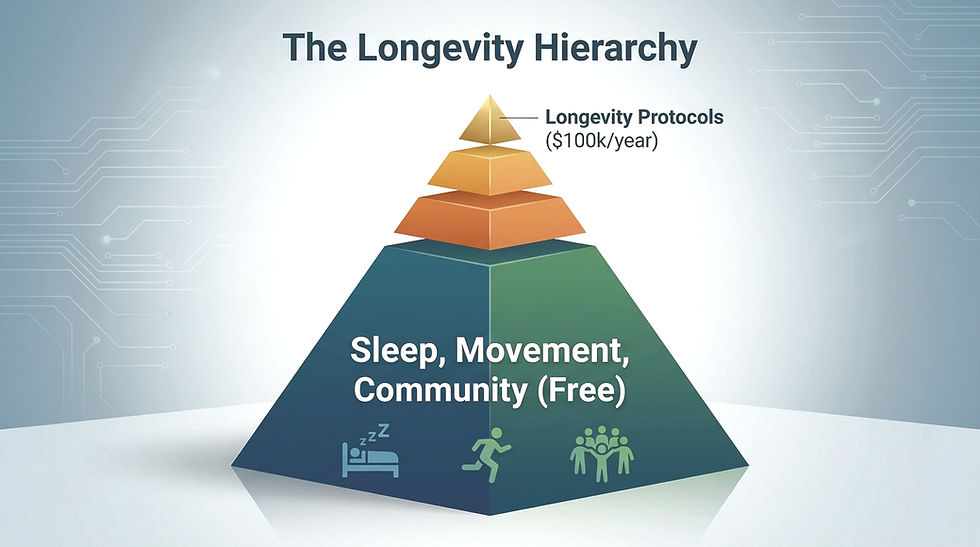
The Nervous System is the Longevity Engine: This is the most overlooked truth. The state of your autonomic nervous system is a primary regulator of your biological age. Chronic activation of the sympathetic "fight-or-flight" response drives the inflammatory and metabolic dysfunction that ages you. Actively down-regulating this stress through techniques like breathwork, meditation, or simply time in nature is a powerful, cost-free medical intervention.
Metabolic Health is Foundational: You don't need continuous glucose monitors and expensive supplements to maintain metabolic flexibility. The cornerstones are simple: regular movement to improve insulin sensitivity and a diet rich in whole foods. These basic habits form the bedrock of a long healthspan.
Community is a Clinical Intervention: Social connection is not a "soft" skill; it is a biological necessity. Studies have repeatedly shown that individuals with strong social ties live longer, healthier lives than their isolated peers, sometimes with an impact on mortality risk comparable to quitting smoking. Loneliness creates a chronic stress state that is a direct assault on the body.
The Road Ahead
The tech elite are chasing immortality. But the real work of extending human healthspan will not be the result of a single, expensive breakthrough. It will be the culmination of democratizing what we already know works.
Future implementation must focus on public health. We need to build environments that support movement, social connection, and access to healthy food. We need to teach stress regulation as a core life skill. Regulatory hurdles are also needed to curb the misleading marketing claims that plague the supplement and bio-hacking industries.
The long-term human impact of the longevity gold rush depends on the choices we make now. A world where only the rich can afford to age slowly is not a healthier world; it’s a more divided one. The most powerful tools for a long and healthy life are not for sale. They are already within our reach.
Frequently Asked Questions (FAQs)
Is longevity science real?
Yes, the scientific research into the biological mechanisms of aging, like senescent cell clearance and epigenetic reprogramming, is a legitimate and promising field.
Are the expensive protocols of billionaires effective?
Some may be, but many are experimental and lack long-term data. Their effectiveness is often exaggerated for marketing, and they are out of reach for the vast majority of people.
What is the biggest factor in accelerated aging?
While genetics play a role, chronic stress is one of the most powerful drivers of inflammation and metabolic dysfunction, which are key components of the aging process.
What is the most effective "free" longevity tool?
Regulating your nervous system. Practices that reduce chronic stress, like mindful breathing, quality sleep, and social connection, have a profound impact on slowing biological aging.
What is healthspan inequality?
It’s the documented gap in which people with lower socioeconomic status tend to experience chronic disease and age-related decline earlier in life than wealthier individuals.
Sources
Belsky, D. W., Caspi, A., Houts, R., Cohen, H. J., Corcoran, D. L., Danese, A., et al. (2015). Quantification of biological aging in young adults. Proceedings of the National Academy of Sciences, 112(30), E4104–E4110. https://doi.org/10.1073/pnas.1506264112
Holt-Lunstad, J., Smith, T. B., & Layton, J. B. (2010). Social relationships and mortality risk: A meta-analytic review. PLoS Medicine, 7(7), e1000316. https://doi.org/10.1371/journal.pmed.1000316
Kiecolt-Glaser, J. K. (2010). Stress, inflammation, and yoga practice. Psychosomatic Medicine, 72(2), 113–121. https://doi.org/10.1097/PSY.0b013e3181cb9377
Partridge, L., Deelen, J., & Slagboom, P. E. (2018). Facing up to the global challenges of ageing. Nature, 561(7721), 45–56. https://doi.org/10.1038/s41586-018-0457-8
Sinclair, D. A., & LaPlante, M. D. (2019). Lifespan: Why we age—and why we don’t have to. Atria Books.


