"Forever Chemicals" in Your Tap Water? A Guide to Testing and Filtering


With the EPA enforcing new standards, here is a guide to testing, filtering, and keeping your family safe.

There's a high probability that the water you drink every day contains PFAS, industrial compounds linked to serious health issues. With the EPA now enforcing new national standards, here is a simple, no-nonsense guide to testing, filtering it and protecting your family.
The term "forever chemicals" is alarming, and recent EPA announcements have brought a hidden public health issue into the national spotlight, causing widespread anxiety. This article is important because it converts that anxiety into an actionable plan. Instead of just reporting on the problem, it provides a methodical, step-by-step guide based on scientific data and consumer-level solutions. It equips you with the precise information needed to protect your family's health in a world where water quality can no longer be taken for granted.
Key Takeaways
PFAS ("forever chemicals") are widespread industrial contaminants that do not break down and accumulate in the body.
The EPA has now set legally enforceable limits for PFAS in drinking water, prompting action from water utilities.
You can check your local water quality through your utility's report or use a certified at-home lab test.
The most effective filters for removing PFAS are reverse osmosis and activated carbon systems certified by NSF/ANSI 53.
Boiling water does not remove PFAS; it can actually increase their concentration.
PFAS in Your Tap Water? Here’s Exactly How to Test It, Filter It, and Protect Yourself
As a medical scientist at Biolife Health Center, I work with data that tells stories about human health. Right now, one of the most urgent stories is being told by water quality reports from across the nation. It’s about a class of compounds called PFAS—per- and polyfluoroalkyl substances. You may know them by their more common name: "forever chemicals."
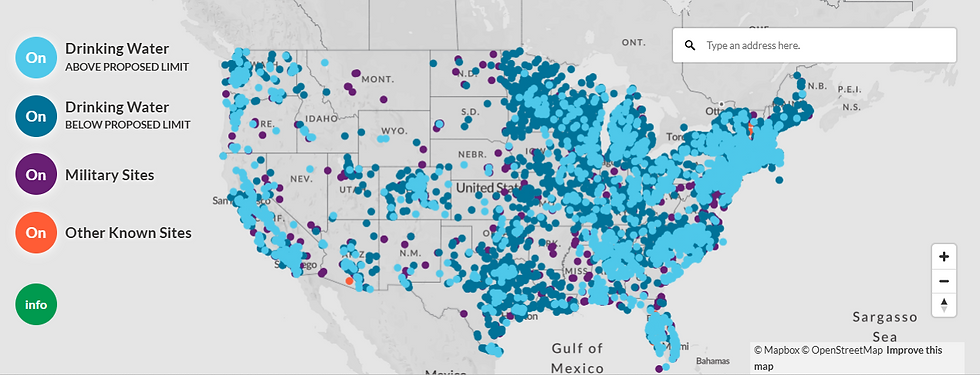
PFAS contamination in the U.S. (August 14, 2025) https://www.ewg.org/interactive-maps/pfas_contamination/map/
For decades, these invisible compounds have been accumulating in our environment and our bodies. The recent surge in public concern is not unwarranted; it's a direct response to new, legally enforceable drinking water standards from the Environmental Protection Agency (EPA) that went into effect in September 2025.
The public response is clear from the data: Google searches for "PFAS water test" are up 400%, and communities are asking what this all means for their family's health. My goal here is not to cause alarm, but to provide a clear, methodical plan of action. Let's walk through the science and the solutions.
Step 1: Understand the Contaminant
Before you can solve a problem, you must define it. PFAS are a family of thousands of man-made chemicals used since the 1940s in products like non-stick pans (Teflon), waterproof jackets, and firefighting foam.
Why are they called "forever chemicals"? Their carbon-fluorine bond is one of the strongest in organic chemistry. They do not break down in the environment or in our bodies, meaning they accumulate over time.
What are the health risks? The CDC and EPA have linked PFAS exposure to a range of health problems, including increased risk of some cancers (kidney, testicular), thyroid disease, immune system suppression, and developmental issues in children.
Step 2: Test Your Water
You cannot see, smell, or taste PFAS. The only way to know if they are in your water is to test for them. You have two primary methods.
Method A: Check Public Data (Free) Your first stop should be your local water utility. Every year, they are required to provide a Consumer Confidence Report (CCR) that details the levels of contaminants found in your drinking water. Look for the section on PFAS or "unregulated contaminants." Additionally, organizations like the Environmental Working Group (EWG) maintain a nationwide PFAS contamination map that aggregates data from multiple sources.
Method B: Use a Certified Lab Test (Paid) For definitive results from your own tap, you can order an at-home water test kit. This is not a simple dip stick; you will collect a sample and mail it to a state-certified or EPA-certified laboratory for analysis. This is the most accurate way to understand your personal exposure.

Step 3: Filter Your Water Effectively
If you've confirmed PFAS in your water or simply want peace of mind, a water filter is your most effective tool. However, not all filters are created equal. Many common filters do nothing to remove PFAS.
What DOES Work:
Gold Standard: Reverse Osmosis (RO) Systems: These systems use a semi-permeable membrane to force water through, leaving contaminants behind. Under-sink RO systems are highly effective, with data showing they can remove over 90% of PFAS compounds.
Effective & Accessible: Activated Carbon Filters: These filters use carbon to adsorb (trap) PFAS molecules. Look specifically for filters with granular activated carbon (GAC) or solid carbon blocks.
Crucial Detail: The filter MUST be certified NSF/ANSI 53 for PFAS reduction. This certification ensures it has been independently tested to meet specific standards. Many pitcher and faucet-mounted filters carry this certification. |
What DOES NOT Work:
Boiling Water: This is a dangerous misconception. Boiling water will not remove PFAS. As the water evaporates, it will actually increase the concentration of the chemicals left behind.
Standard Sediment Filters: The filters that simply remove rust or debris from water do not stop dissolved chemicals like PFAS.
Filter Type | Effectiveness on PFAS | Typical Cost | Certification to Look For |
Reverse Osmosis (RO) | High (90%+) | $$$ (Under-sink / Whole-house) | NSF/ANSI 58 (RO systems) |
Activated Carbon | Moderate to High (varies by filter quality) | $–$$ (Pitchers, Faucet Mounts, Under-sink) | NSF/ANSI 53 for PFAS reduction |
Anion Exchange Filters | High (specially designed resins can remove PFAS) | $$–$$$ (Specialized cartridges or whole-house) | NSF/ANSI 53 (if PFAS-certified) |
Distillation Units | Moderate to High (removes many PFAS, but slow) | $$–$$$ (Countertop units) | No common PFAS-specific certification |
Water Softener | None (does not remove PFAS) | $$ (Whole-house) | N/A |
Boiling Water | Harmful (concentrates PFAS instead of reducing) | $0 | N/A |
Step 4: Advocate for Broader Change
Filtering your own water is an important defensive measure, but the ultimate solution is to stop contamination at its source. As a citizen, your voice has weight.
Engage Locally: Attend your town or municipal water board meetings. Ask them directly: "What is our town's plan for meeting the new EPA standards for PFAS?"
Support Informed Policy: Advocate for policies that hold polluters accountable and provide funding for water infrastructure upgrades.
Spread Awareness: Share credible, science-based information with your community. The more people who understand the issue, the greater the pressure for systemic solutions.
Final Thought
The presence of "forever chemicals" in our water is a complex problem born from decades of industrial pollution. But facing this challenge does not have to be overwhelming. By methodically testing your water, choosing a scientifically validated filter, and engaging with your community, you can take meaningful control. This is not a moment for panic; it is a moment for informed action.
FAQs
Is bottled water a safer alternative to tap water?
Not necessarily. The bottled water industry is not subject to the same rigorous public reporting as municipal water utilities. Some studies have found PFAS in bottled water, and there is no guarantee that it is any cleaner than filtered tap water unless the brand specifically tests and certifies for PFAS removal.
Should I throw away my non-stick pans?
Modern non-stick pans made after 2013 should not contain PFOA (one of the main PFAS chemicals of concern). The primary risk from pans is from high-heat cooking (over 500°F / 260°C) with older or scratched pans, which can release fumes. The far greater source of exposure for most people is contaminated drinking water.
How often should I change my water filter?
Follow the manufacturer's instructions precisely. An overused carbon filter can become saturated and may actually release the trapped contaminants back into the water at a higher concentration. It is critical to replace filter cartridges on schedule.
Will my city’s water utility eventually fix this problem?
With the new, legally enforceable EPA standards, all public water utilities are now required to test for PFAS and take action to reduce them below the legal limit if they are too high. However, these upgrades can take years and are very expensive, so a home filter remains the best immediate solution for personal protection.
Are there any health symptoms of PFAS exposure?
PFAS exposure does not cause immediate, acute symptoms. The health concerns are related to long-term accumulation in the body, which can increase the risk of chronic diseases over time. This is why prevention and reducing exposure are so important.
Sources
United States Environmental Protection Agency (EPA). (2025). PFAS National Primary Drinking Water Regulation. epa.gov.
Centers for Disease Control and Prevention (CDC). (2022). PFAS and Your Health. cdc.gov/pfas.
Environmental Working Group (EWG). (2025). PFAS Contamination in the U.S. https://www.ewg.org/interactive-maps/pfas_contamination/map/
About Larrie Hamilton, BHC, MHC
As a medical scientist, I combine research expertise with a passion for clear communication at Biolife Health Center. I investigate innovative methods to improve human health, conducting clinical studies and translating complex findings into insightful reports and publications. My work spans private companies and the public sector, including BioLife and its subsidiaries, ensuring discoveries have a broad impact. I am dedicated to advancing medical knowledge and creating a healthier future. Follow me on LinkedIn.